
List of Topic Covered
Why gift mutual funds this Diwali?
Sweets get eaten and gadgets go out of date. Mutual fund units keep growing. This Diwali you can gift mutual funds straight from your folio to a loved one, without selling them first. And if you choose the right person, you can also cut your family’s tax bill.

But there is a catch. Who gets the gift decides who pays the tax. Gift units to your HUF or your spouse and the tax usually comes back to you. Gift them to your adult daughter, son or parents and the tax moves with the units.
Quick answers
Yes. Since 2025 you can transfer even non-demat (statement of account) units online through CAMS, KFintech or MF Central.
No tax for you when you gift. No tax for a “relative” who receives it, whatever the amount.
The person who sells, unless clubbing rules apply. Clubbing applies to gifts to your spouse, your son’s wife, your minor child and your HUF.
Gift to an adult child or parent with little income. They use their own ₹1.25 lakh LTCG exemption and their unused basic exemption limit.
A 10-day wait before the receiver can redeem, a small 0.015% stamp duty, and no transfers to minors.
Can you gift mutual funds held in non-demat form?
Yes. Until 2024, you could only gift mutual funds held in a demat account. Most investors hold units as a statement of account (SoA), so they had to redeem, pay tax and reinvest in the other person’s name.
SEBI changed this in phases.
- Phase 1 went live on 14 November 2024 and covered joint holders and nominees.
- Phase 2, from 19 May 2025, allowed full transfer of SoA units to relatives and even third parties, entirely online.
SEBI and RTA rules you must know
- Where: online only, on the CAMS, KFintech or MF Central portals.
- Eligible schemes: all schemes except ETFs. Solution-oriented schemes (retirement and children’s funds) are excluded too.
- KYC: both giver and receiver must be KYC-compliant. The receiver needs a folio with the same fund house, which can be opened during the process.
- Blocked units: units under lien, freeze or lock-in (for example ELSS within its 3 years) cannot be transferred.
- No minors: transfers to or from a minor’s folio are not allowed.
- NRIs: rules vary by RTA and AMC. Check before you start; the giver handles any tax on their own return.
- Partial transfer: allowed. You can gift some units and keep the rest.
- No exit load is charged on the transfer.
- 10-day cooling period: the receiver cannot redeem the units for 10 days after transfer.
- Irreversible: once done, a gift cannot be cancelled.
- Stamp duty: 0.015% of the value transferred. On a ₹10 lakh gift, that is just ₹150.
- Gift deed: not insisted on today, but the AMC or RTA may ask for documents. Keep a simple signed gift deed anyway; it is your best proof if the tax officer asks.
Tax rules when you gift mutual funds
Four rules decide the tax. Note that the Income-tax Act, 2025 replaced the 1961 Act from 1 April 2026. The substance of these rules is the same; only the section numbers changed. Returns for FY 2025-26 still use the old numbers.
1. No capital gains tax for the giver : A gift is not a sale. You receive nothing, so no capital gains arise in your hands when you gift units.
2. Gift tax for the receiver: relatives are exempt : If someone receives gifts worth more than ₹50,000 in a year, the whole amount is taxed as their income. Gifts from “relatives” are fully exempt, whatever the value. This rule was Section 56(2)(x) and is now Section 92 of the 2025 Act.
Relatives include your spouse, children, parents, siblings, and their spouses. For an HUF, every member counts as a relative. So a gift from you to your HUF or to your daughter is tax-free on receipt.
3. Clubbing: the trap that brings the tax back : The gift is tax-free, but the income from it may still be added to your income. This is clubbing (old Section 64, now Section 99).
- Spouse: income from gifted assets is clubbed with yours.
- Son’s wife (daughter-in-law): clubbed with yours.
- Minor child: clubbed with the higher-earning parent, with a tiny exemption of ₹1,500 per child.
- HUF: if you are a member and gift your own asset to the HUF, its income is clubbed with yours. This continues even if the asset changes form, and until the HUF is fully partitioned.
- Adult children, parents, siblings: no clubbing. The income is theirs.
4. Cost and holding period carry over : The receiver steps into your shoes. Their cost is your original cost, and their holding period starts from your purchase date. So units you bought 10 years ago are long-term for your daughter from day one.
For equity units bought before 1 February 2018, grandfathering also carries over. The cost is the higher of your actual cost and the NAV on 31 January 2018 (capped at the sale value).

Current equity mutual fund tax rates
| Holding | Tax on Gains | Exemption |
| 12 months or less (STCG) | 20% | None |
| More than 12 months (LTCG) | 12.5% | First ₹1.25 lakh a year (old Section 112A, now Section 198) |
Budget 2026 left these rates unchanged. Add 4% cess, plus surcharge for high incomes.

One more useful rule: a resident individual or HUF can set any unused basic exemption limit against LTCG. Someone with no other income can therefore earn ₹4 lakh (new-regime limit) plus ₹1.25 lakh, or ₹5.25 lakh of equity LTCG, tax-free in one year. The new-regime ₹12 lakh rebate does not cover special-rate LTCG, so do not count on it.
HUF, spouse or daughter: who should you gift mutual funds to?
Gift to an adult child or a parent if your goal is to save tax. Gifting to your HUF or spouse only moves the paperwork, not the tax.
| Receiver | Taxed on receipt? | Clubbing? | Who pays tax on the gains | Tax saving? |
| Your HUF (you are a member) | No | Yes, until full partition | You | None |
| Spouse | No | Yes | You | None |
| Daughter-in-law | No | Yes | You | None |
| Minor child | Not allowed under the SoA route | Yes | Higher-earning parent | None |
| Adult daughter or son | No | No | The child | Yes, if their income is low |
| Parents or in-laws | No | No | The parent | Yes, often the best option for retired parents |
| Siblings | No | No | The sibling | Yes, if their income is low |
| Friend or non-relative | Yes, if gifts exceed ₹50,000 in the year | No | The friend | Rarely |
Worked example: how much tax can you save?
Let’s understand this with the help of an example,
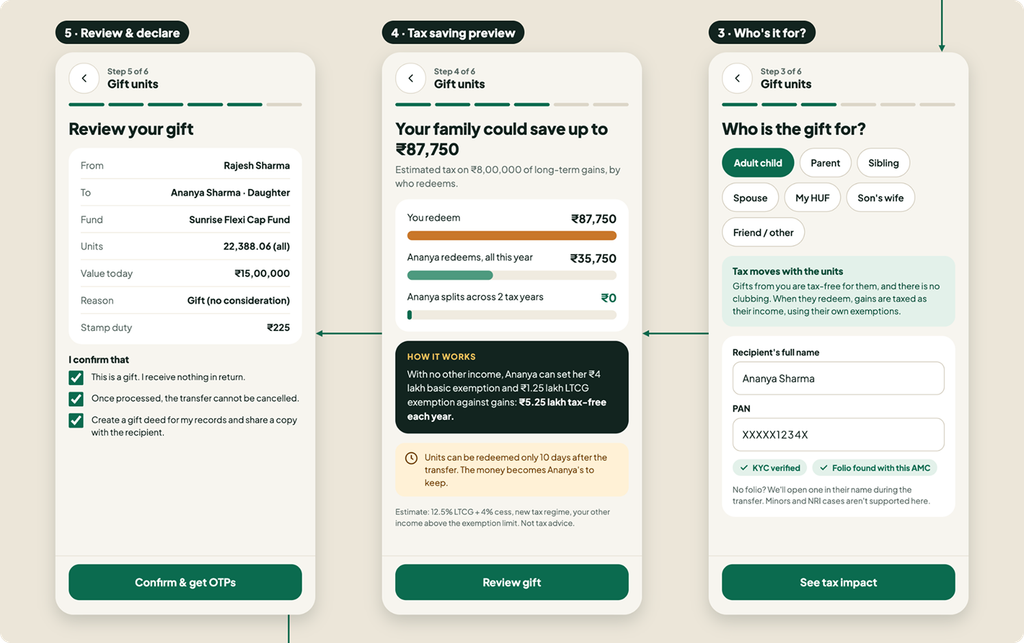
Gifting to an adult daughter with no income can cut the tax on ₹8 lakh of gains from ₹87,750 to zero.
Assume Mr Sharma invested ₹5 lakh in an equity fund in 2016. Its value on 31 January 2018 was ₹7 lakh, and today it is worth ₹15 lakh. Under grandfathering, his cost is ₹7 lakh, so the long-term gain is ₹8 lakh. He already has a salary above the basic exemption limit. His daughter is 24, a student, with no income.
| Who redeems | Gain | Tax-free portion | Taxable LTCG | Tax at 12.5% + 4% cess |
| Mr Sharma, all this year | ₹8,00,000 | ₹1,25,000 | ₹6,75,000 | ₹87,750 |
| Mr Sharma’s HUF (clubbed back to him) | ₹8,00,000 | ₹1,25,000 | ₹6,75,000 | ₹87,750, paid by Mr. Sharma |
Daughter, all this year | ₹8,00,000 | ₹5,25,000 | ₹2,75,000 | ₹35,750 |
| Daughter, split across two tax years | ₹5,25,000 + ₹2,75,000 | All of it | Nil | Nil |
The split works because each tax year gives her a fresh ₹4 lakh basic exemption and ₹1.25 lakh LTCG exemption. She would redeem about two-thirds of the units before 31 March 2027 and the rest after 1 April 2027.

Two honest caveats. First, Mr Sharma could also spread his own redemptions over several years to use his ₹1.25 lakh exemption each year. Second, the money now belongs to his daughter. If it quietly flows back to him, the tax officer may treat the gift as a sham.

Figures use the new-regime basic exemption of ₹4 lakh. Check the slab for the year you redeem.
How to gift mutual funds: step-by-step process
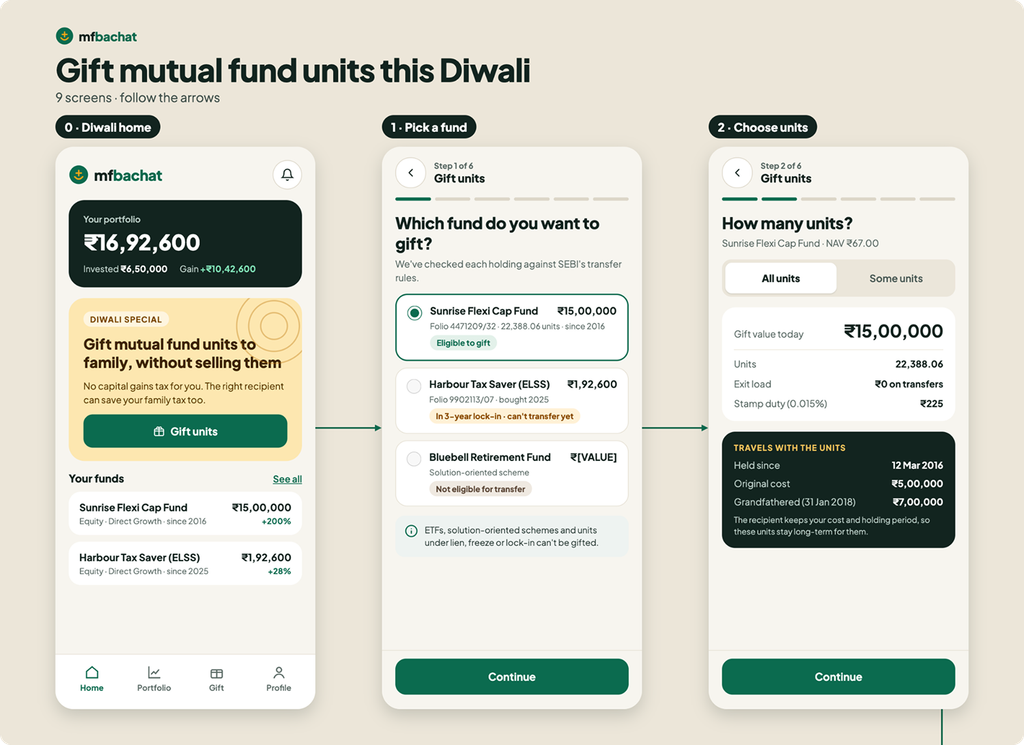
The SoA transfer is done fully online in one sitting. Here is the flow on CAMS, KFintech or MF Central.
- Check eligibility. Confirm the scheme is not an ETF or solution-oriented fund, and the units are free of lock-in or lien.
- Get the receiver ready. They need completed KYC, PAN, a registered mobile and email, and a bank account.
- Log in as the giver on the RTA portal or MF Central and choose “Transfer of units”.
- Pick the folio, scheme and units (all or part) and choose “Gift” as the reason.
- Enter the receiver’s details. Use their existing folio with that fund house, or open a new one in the flow.
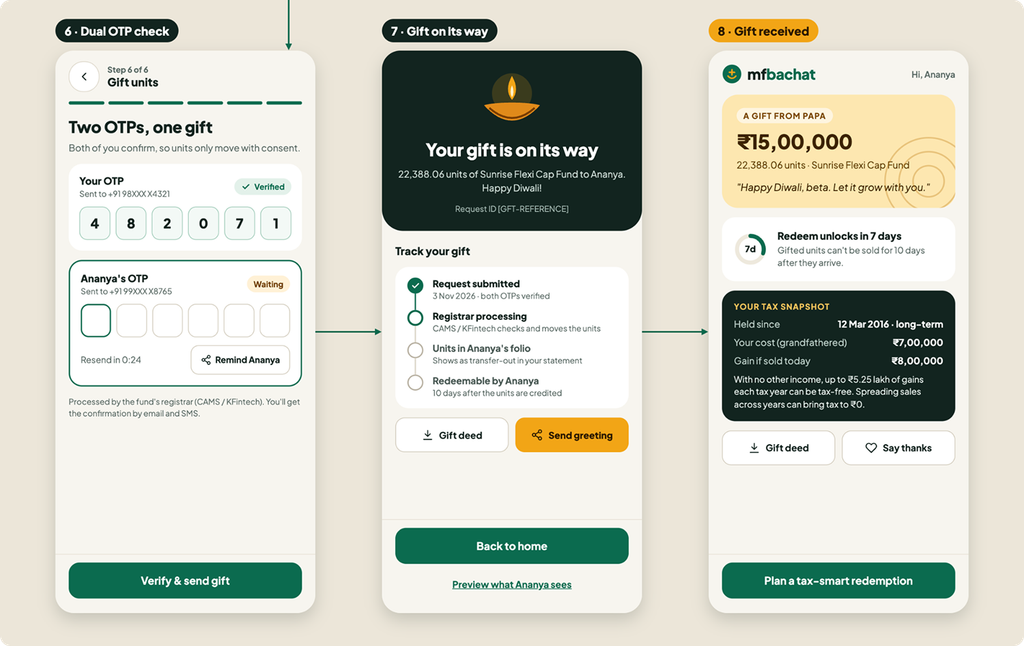
- Verify with OTPs sent to both giver and receiver.
- Pay stamp duty of 0.015% if asked.
- Track and save proof. Download the transfer confirmation. Keep it with a signed gift deed and the original purchase statement.
- 9. Wait 10 days before the receiver redeems or switches.
Common mistakes when you gift mutual funds
- Gifting to your HUF or spouse to save tax. Clubbing sends the tax straight back to you.
- Planning to redeem on Diwali day. The receiver must wait 10 days after the transfer.
- Ignoring the receiver’s other income. The saving comes from their unused exemptions. If they earn well, the saving shrinks.
- Round-tripping the money. A gift must be real. If the redemption money comes back to you, it can be challenged.
- Forgetting the paperwork. Keep the gift deed, transfer confirmation and your original purchase NAVs. The receiver needs your cost to file their return.
- Transferring ELSS too early. Units still in the 3-year lock-in cannot move.
- Expecting the ₹12 lakh rebate to cover LTCG. It does not apply to special-rate capital gains.
- Mixing up rules for non-relatives. A friend receiving more than ₹50,000 pays tax on the gift itself.
Fun facts to share over Diwali sweets
- India once had a gift tax. The Gift Tax Act ran from 1958 until it was abolished in 1998. Today’s ₹50,000 rule is its quiet successor.
- India’s first mutual fund scheme was US-64, launched by UTI in 1964. A gifted SIP today joins a 60-year-old idea.
- The ₹1,500 minor child exemption from clubbing has stayed the same for decades. It barely buys a box of kaju katli.
- 31 January 2018 is equity investors’ “birthday”. Gains up to that date are grandfathered, even in your daughter’s hands.
- Fewer sections, same rules. The new Income-tax Act, 2025 has 536 sections, down from 819, but clubbing survived the cut.
- Stamp duty on a ₹10 lakh gift is ₹150. That is cheaper than most Diwali gift wrapping.
FAQs on Gifting Mutual Funds
You can gift them, but the gains are clubbed with your income. You save no tax.
No. A parent is a relative, so the gift is exempt. She pays tax only when she redeems, at her own rates.
Yes. Your purchase date and cost carry over, including grandfathering for pre-2018 equity units.
Not through the SoA transfer facility. You can invest in the child’s name instead, but income is clubbed with yours.
RTAs do not insist on one today, but keep one. It proves the transfer was a genuine gift.
No exit load. Stamp duty of 0.015% applies on the transfer value.
The bottom line
To gift mutual funds this Diwali is both thoughtful and tax-smart, if you pick the right person. Gift to an adult child or parent with low income, keep the paperwork clean, wait out the 10 days, and spread redemptions across tax years. Skip the HUF and spouse route if tax saving is the goal.
This article is for information only and is not tax or investment advice. Tax law changes; consult a chartered accountant before acting.