
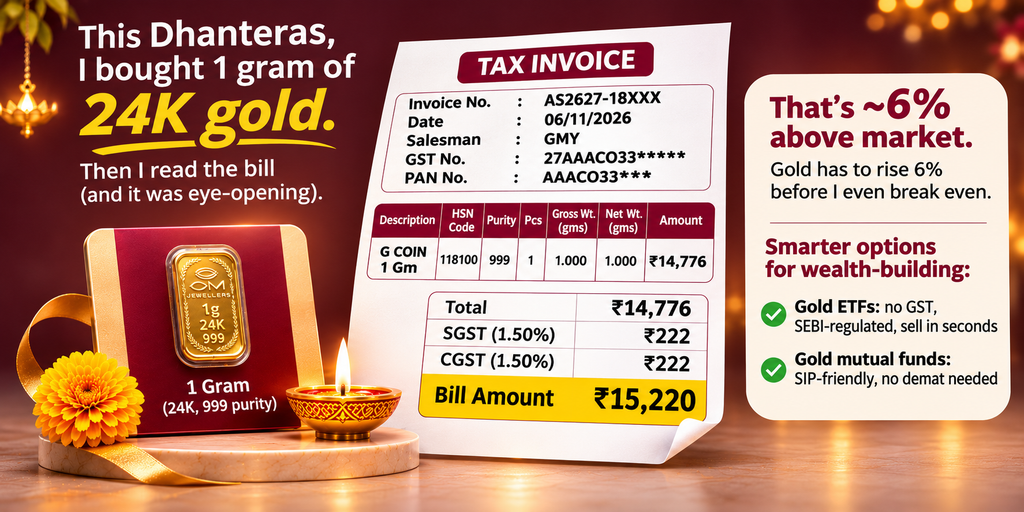
Gold ETF vs physical gold: which one gives you more for your money? This Dhanteras, I found out with my own cash. On 6 November 2026, I bought a 1 gram, 24K gold bar from a reputed Mumbai jeweller. Afterwards, I checked the bill against the market rate. The difference surprised me.
List of Topic Covered
What I Paid for 1g of Gold on Dhanteras
Here is the exact breakdown from my tax invoice.
| Item | Amount |
| 1g 24K gold bar (999) | ₹14,776 |
| GST @ 3% (1.5% CGST + 1.5% SGST) | ₹444 |
| Total paid | ₹15,220 |
How My Price Compared With the Market Rate
Interestingly, gold fell about 1.8% on Dhanteras this year. Published 24K rates for the day ranged from roughly ₹14,100 to ₹14,540 per gram. A widely quoted national rate was ₹14,346 per gram.
| Comparison | Per gram |
| Market rate (24K, before GST) | ~ ₹14,346 |
| Jeweller’s price (before GST) | ₹14,776 |
| Premium over market | ~ ₹430 (about 3%) |
| Total cost with GST | ₹15,220 |
| Total above market rate | ~ ₹874 (about 6%) |
In short, I paid about ₹874 more than the gold was worth that day.
Gold ETF vs Physical Gold: The Two Hidden Costs
Physical gold carries two extra costs. A gold ETF carries neither.
1. The premium (2–10%). This is the seller’s charge above the market rate. It covers minting, packaging, the certificate card and profit. Larger bars sit near 2–3%. Tiny coins and bank coins can reach 8–10%.
2. GST (3%). The government charges 3% GST on every physical gold purchase. It applies to the price including the premium. You never get it back.
As a result, three things follow:
- You start about 6% behind. Gold must rise roughly 6% before you break even.
- Buyback happens at the jeweller’s rate. They value your gold on the day you sell, and deductions can apply.
- There is no HUID hallmark. Hallmarking isn’t mandatory below 2g. So, purity rests on the jeweller’s word. A BIS-recognised assaying centre can test it if needed.
Was It Still a Good Dhanteras Buy?
Yes, as a festival purchase. A 3% premium on a 1g bar is normal. Buying from an established jeweller with a GST invoice is also the right approach. However, as an investment, it is the most expensive route.
Other Ways to Invest in Gold
Thankfully, physical gold is not your only choice. Here is how the main options compare.
| Option | Extra cost to buy | Regulated? | Best for |
| Physical coin or bar | 3% GST + 2–10% premium | BIS (hallmarked items) | Festivals, gifting, tradition |
| Gold ETF | No GST; small expense ratio + brokerage | SEBI | Low-cost investing (needs demat) |
| Gold mutual fund | No GST; slightly higher total fee | SEBI | Monthly SIPs without demat |
| Digital gold | 3% GST + buy-sell spread | Not by SEBI or RBI | Very small amounts only |
| Sovereign Gold Bonds | No new issues since Feb 2024 | Government of India | Secondary market only |
For example, the same ₹15,220 in a gold ETF would have bought roughly 1.05g worth of gold.
Gold ETF vs Gold Mutual Fund
Both track the price of gold. The difference lies in how you buy them.
- A gold ETF trades on the stock exchange like a share.
- A gold mutual fund, also called a fund of funds (FOF), buys that same ETF for you.
Nippon India shows this clearly. Its Gold Savings Fund holds almost 100% in Nippon India ETF Gold BeES. Same gold, different wrapper.
| Gold ETF | Gold mutual fund | |
| How to buy | On NSE/BSE via a broker, in market hours | Via an MF app or the AMC, at end-of-day NAV |
| Demat account | Required | Not needed |
| Minimum | Price of 1 unit (about ₹120–130) | SIPs from ₹100 |
| Cost | Expense ratio + brokerage | Own fee + the ETF’s fee inside it |
| Long-term tax | 12.5% after 12 months | 12.5%, usually after 24 months |
There is one catch. A gold fund's quoted fee looks tiny, but you also pay the ETF's fee inside it. Therefore, the fund always costs slightly more than the ETF alone.
Top Gold ETFs and Gold Funds Compared
Note that we have used expense ratio and tracking error to compare. tracking error gives you an idea about how closely a fund follows the real gold price. Lower is better.
Top gold ETFs
| ETF | Expense ratio | Tracking error | AUM | AUM as of |
| HDFC Gold ETF | 0.59% | 0.39% | ₹22,836 cr | 31 Oct 2026 |
| SBI Gold ETF | 0.65% | 0.43% | ₹25,710 cr | 31 Oct 2026 |
| Nippon India ETF Gold BeES | 0.69% | 0.40% | ₹56,982 cr | 30 Sep 2026 |
Top gold mutual funds (Direct plans)
| Fund | Own Fee | +ETF Fee | Approx Total | AUM | AUM as of |
| Nippon India Gold Savings | 0.05 – 0.06% | 0.69% | ~ 0.75% | ₹7,353 cr | 30 Sep 2026 |
| HDFC Gold ETF FoF | 0.09 – 0.20% | 0.59% | ~ 0.68 – 0.79% | ₹11,488 cr | 31 Oct 2026 |
| SBI Gold Fund | 0.21 – 0.24% | 0.65% | ~ 0.86 – 0.89% | ₹17,423 cr | 30 Sep 2026 |
AUM figures are month-end values from each fund house's website or its latest published factsheet. Fee figures also vary slightly between data sources, so always check the latest AMC factsheet.
Gold ETF vs Physical Gold: Cost on ₹1 Lakh
| Option | Rough Cost |
| Gold ETF (HDFC) | ~ ₹600 a year + small brokerage |
| Gold fund (HDFC or Nippon) | ~ ₹700 – 800 a year, no demat needed |
| Physical gold | ~ ₹6,000 lost upfront + buyback deductions |
| Sovereign Gold Bonds | No new issues available |
In other words, a full year of ETF fees costs about a tenth of what a coin loses upfront.
Tax on Gold Investments
Gold ETFs held over 12 months attract 12.5% long-term capital gains tax, without indexation. Gold mutual funds and physical gold usually need 24 months for the same rate. Check the current rules before you sell.
Final Verdict: The Best Way to Buy Gold in 2026
- Best overall: HDFC Gold ETF. It has the lowest cost and tracking error of the big three. Choose it if you have a demat account and invest lump sums.
- Best for SIPs: HDFC Gold ETF FoF or Nippon India Gold Savings Fund (Direct). Both cost about the same. Pick the one with the lower fee on its latest factsheet.
- Physical gold: for festivals only. Buy a small coin for tradition, keep the invoice, and compare the rate first.
Also, always pick the Direct plan for mutual funds, because Regular plans charge more. Finally, keep gold to about 5 – 15% of your portfolio.
This Diwali, I bought gold for tradition. Next month, I’ll start a gold SIP for wealth.
FAQs on Gold ETF vs Physical Gold
For investing, yes. A gold ETF has no GST, no premium and no storage risk. You can also sell it instantly at close to the market price. Physical gold suits gifting and festivals better.
Yes. If you don’t have one, choose a gold mutual fund instead. It invests in a gold ETF and needs no demat account.
Not new ones. The government has not issued fresh SGBs since February 2024. Older bonds trade on the stock exchange, but secondary buyers no longer get tax-free maturity.
This is a personal write-up, not financial advice. Rates are indicative and vary by city and source.